A guide for the peaceful and rapid transition of the economy
1. Foreword
Our capitalist economy actually works quite simply. The struggle for higher wages and rising prices alternate periodically.
That’s all you need to know. But it wouldn’t hurt to think about it.
This spiral of growth also ensures that more and more people are being drawn away from the unpaid care sector and into production, thus further weakening the care sector.
Food, clothing and medical care for all people would actually be much more important. But building cars and motorways generates higher wages and profits. That is why the car industry is particularly important to the state – and our roads and cities are overflowing with cars.
But of course, wages and social benefits should not fall.
What does the state do when people don’t buy enough cars? It buys tanks and warships on credit. All it needs is an enemy, and then the billions start flowing. And just like that, wages and social benefits are secured for the next few months.
We are thus placing a powder keg in the basement that could explode at any moment.
But is there an alternative?
There are two ancient laws that have been forgotten.
One is the law of free raw materials and energy. The proof of this is that we do not have to transfer money to the earth and the sun.
And then there is the law of free labour. The proof of this is that everything that happens to prevent humanity from dying out, i.e. giving birth and raising children, as well as ensuring that work can continue the next day, happens without pay. This area is even larger than that of paid work in production, because the whole of civil society also operates on a voluntary basis.
If we combine both laws, wages, the main cause of destructive growth, can be eliminated.
Because when free natural resources are combined with free labour, the products are also free, i.e. available at no cost. Because if we work unpaid in the economy as well as in the care sector, then the gifts of creation would remain free. Nothing would need to be bought anymore, so we would no longer need wages at all.
In this unpaid care sector, there are no wage increases and no pressure to grow. We are happy about every new recipe that makes food taste better – but we don’t cook twice as much as the economy is forced to do. In this sector, there are always improvements, but no artificially created abundance.
In fact, the care sector only needs the inflated economy as a tool to provide food, clothing, housing, medical care and some of the finer things in life. This economic “tool” could basically function in the same way as the unpaid care sector. There is no objective reason why this should not be the case.
Then there would be no more overproduction in the economy either. Less would be manufactured, climate targets would be within reach, and the shortage of raw materials would come to an end.
Unfortunately, the economy has slipped out of our grasp. The banks control wages and profits, and the stock market resembles a giant casino. This financial system ensures that it is not people’s needs that are decisive, but financial efficiency.
In this system, CEOs do not act as sentient human beings, but as the control centres of the purely legal entities that employ them. They are merely the human executors of an inhuman mathematical operation. Tanks and warships are far more useful to the financial system than ‘bread for the world’.
Indirectly, of course, this system helps to secure social benefits, as many of these benefits are financed by interest income. That is why the financial system is pampered and coddled by governments.
So much for democracy.
If we want to try to convert the economy to the wage- and growth-free principle of unpaid care work, we cannot hope for help from governments. We are completely on our own.
Nor can we ‘convert’ the economy in advance or change it gradually – the financial system does not allow this because the two are perfectly coordinated. Nevertheless, we have a real chance of occupying the economy in the short term.
We need a similar ruse to the one David used to defeat the mighty Goliath.
This is where the two laws of nature come into play.
If the free gifts of creation were processed and transported without payment, all the products resulting from them would remain free. It is almost too simple to believe, but it is indeed the case.
The proof that this principle works lies in the care sector itself. We buy the ‘means of reproduction’, such as vegetables and salt for the soup, at the market. Once they have been paid for, they only have a use value and form the free basis for care work. Because we do not receive any wages for cooking, we can offer the soup to our children without them having to pay for it.
In production, it would not be soup, but perhaps steel – extracted from the gifts of iron ore and coal. If everyone worked there without pay, the spade made from it would be free.
If the farmer cultivates his field, sows and harvests without pay, he can give the grain to the miller. The miller gives the flour to the baker, and the baker gives us the bread.
The owner of the field is compensated for receiving everything necessary for life free of charge – just like our children receive the soup. He does not need rent, just as factory owners no longer need profit. Because everything we need to live is then just as free as the daily food on every lunch table around the world.
They would not be able to buy anything with rent and profit anyway, because everything is free.
This transition to voluntary work does not have to happen one after the other in a specific order – it can happen simultaneously. We could simply forego our wages on the same day worldwide.
Because of globalisation, this must also happen simultaneously worldwide so that all raw materials, intermediate products and resources become free at the same time.
It would be a global celebration of voluntary work. A big celebration where all goods suddenly become gifts. We know how happy we are when we are invited to free celebrations, or think of Christmas and Easter, which – despite their commercialisation today – are based on the principle of mutual gift-giving.
This euphoria will ensure that the transition is successful.
Many people would like to see gross domestic product replaced one day by gross national happiness – as in the Kingdom of Bhutan. Today, no one knows how this can be achieved. But on the day of voluntary work, we would instantly switch from GDP to GNH. Only happiness would count.
Nothing would have to change in the economy for this transition. Just as a stove, mixing spoon and pot in a snack bar could be used without payment, the economy works just as well with paid work as with voluntary work. It makes no difference to the products – but since wages are no longer paid, all goods become gifts.
We would only have to open everyone’s eyes to the fact that the old natural laws of the gifts of creation and voluntary work still apply – just as they did in archaic society. And we would have to agree on a day when this would happen.
Perhaps 1 May 2027 could be the day of unpaid work.
Many representatives of the post-growth economy or the commons movement are thinking about how the economy would have to change in order to become sustainable. But we know that it cannot be actively changed.
However, it will develop sustainably on its own as soon as it is based on voluntary work, like care work. Then the only thing that counts is what serves people and the earth.
Precise planning is not possible because, in today’s stimulus-saturated society, we hardly know what a life of dignity really looks like. But we do know that there is no longer any need for advertising or calls for more consumption – because no one has any interest in giving away more than necessary. Consumption will therefore decline significantly.
The technical conditions for this change have only been in place for a few years. That is why we no longer need the money-based market. Thanks to the internet, we can communicate our current needs to production in real time. A democratically controlled AI finds the right producers.
Today’s production structures are flexible enough to respond to a decline in demand without causing disruption. When less is produced, people simply spend more time looking after their children, friends or other tasks in civil society.
When we receive everything as a gift, we also feel responsible for taking on unpleasant tasks from time to time. Solidarity is much stronger in a non-capitalist society.
Many who only know capitalism can hardly imagine this today. But I myself lived in such a country for a long time and saw it with my own eyes. You can believe me.
And what will happen to the people in banks, insurance companies or tax offices?
They are free! They, too, are part of the great celebration of giving and receiving gifts, and they will want to return the favour by helping where there is still a lot of work to be done.
Tax offices? We no longer need them, because everyone – teachers, firefighters, university employees, artists and cultural workers – is provided for free of charge. No one is excluded.
When work no longer costs anything, it doesn’t matter how long something takes. Products can be developed in such a way that they can be easily recycled at the end of their useful life. This creates a genuine circular economy – and market allocation becomes obsolete.
This book aims to show that it is still possible to overcome capitalist production relations in time. But it is important that this is discussed worldwide.
It also aims to encourage us to put ourselves in the shoes of such a post-capitalist society in order to understand it. If we really want to overcome capitalism, then we must be able to let go.
Why the name Benharmonia?
How can we look forward to something that has no name? There are many terms for post-capitalist societies, but they are either tongue twisters or burdened by history.
‘Benharmonia’ – a combination of good and harmonious – comes from Latin and is understandable in many cultures.
Let’s look forward to it!
2. The necessity of transforming capitalism
Capitalism has reached its internal and external limits.
It destroys nature, people and social bonds because it can no longer resolve its own contradictions. Growth, competition and profit force a permanent expansion of energy consumption and production – even when the ecological and social limits of the Earth have long been exceeded.
 Figure 1: Global energy consumption
The steady increase in energy consumption and CO₂ concentration is not a temporary anomaly, but rather an expression of the internal logic of the system. Capitalism cannot stand still: any stagnation is considered a crisis, any pause threatens its existence. While natural feedback loops – such as the melting of ice sheets, the thawing of permafrost soils or the accelerated rise in CO₂ in the atmosphere due to large forest fires – accelerate climate change, economic structures such as the increased use of air conditioning due to global warming themselves act as amplifiers of destruction.
The logic of endless growth
In the capitalist mode of production, the material originally provided by nature is transformed into goods through human labour. These goods must be sold so that capital can be realised. If they remain unsold, a crisis arises.
Wages and social security contributions are part of the production costs. If wages fall too much, people refuse to work; if they rise too much, the company becomes unprofitable. For wages to rise, production must therefore grow – and this in turn increases consumption. We know this from the media; the new federal government is calling for ‘more work’ to secure the social system. But any expansion of work also increases the amount of goods that must be consumed.
As a result, we now consume many times more than we actually need. For this cycle to work, products must be replaced as quickly as possible. Planned obsolescence – for example, a printer that breaks down after two years, even though it used to last four years – doubles the production volume for the same demand.
We call ourselves a ‘society of abundance and disposability’ and ignore the consequences – because consumption provides short-term pleasure, while the long-term destruction is externalised. Trust in political control replaces our own reflection on these connections.
The compulsion to grow as a systemic law
More than fifty years ago, the Club of Rome pointed out this dynamic in its report ‘The Limits to Growth’“ (Erich Meadows, 1972) . But the warning went unheeded. Today, we discard many products faster and faster, long before the end of their actual service life, just to replace them with new ones (Siddharth Prakash, 2016). In order for wages and social security contributions to rise, more and more must be produced – an absurd logic that makes endless growth a prerequisite for the system’s survival.
The increase in production is clearly evident. Production requires energy, 86 per cent of which is generated from fossil fuels (Kearney, 2025). This increases the carbon dioxide content of the Earth’s atmosphere. This concentration is measured by the US government’s NOAA Global Monitoring Laboratory (NOAA Network, 2025).

Figure 2: CO2 concentration in the Earth’s atmosphere
Over the last 50 years, it has risen by an average of 2.1 ppm per year. In the last 5 years, this increase has even risen to 2.7 ppm/year. Growth is therefore increasing more rapidly than ever before. Due to the large forest fires caused by global warming, the increase in 2024 was as high as 3.5 ppm.
Those who demand higher wages or social benefits today are unwittingly demanding further growth. But this growth can hardly be generated in a peaceful or meaningful way anymore. The biggest revenues have long been generated by armament, arms exports and post-war reconstruction. The so-called ‘economic miracle’ after the Second World War shows that destruction itself became a prerequisite for new growth. The construction industry is already anticipating major contracts in Gaza and Ukraine.
As soon as one war ends, a new confrontation must be sought so that the machinery does not come to a standstill.
Even natural disasters are now becoming drivers of growth: reconstruction after the floods in the German Ahr Valley in 2021 increased Germany’s gross domestic product by 70 billion euros. Repairing what has been destroyed is becoming the engine of an economy that can no longer function without destruction.
Isn’t it absurd that wars could stop immediately if we were simply willing to give up a quarter of our wages?
The exhaustion of the system
Climate change can probably no longer be completely stopped. At the same time, it is questionable whether a profit-oriented economy is even capable of providing the resources necessary for global coastal protection, reforestation and adaptation measures. The situation is similar with rising social spending due to demographic change: this could only be financed by ever-increasing production.
The surplus required for this is increasingly being generated by neo-colonial structures – through the exploitation of raw materials, labour and land in the Global South.
The compulsion to exploit as a central barrier
As long as the compulsion to exploit capital persists, inequality cannot be overcome. The engine of capitalist production will continue to turn – until it destroys itself and drags down the foundations of human life with it.
The rise of political liberalism since the 1970s is not merely a fad, but an expression of this systemic logic. Just as rising energy consumption is the material form of the compulsion to grow, liberalism embodies its institutional form: it organises the freedom of capital and the adaptation of society to market laws. Despite crises, populism and ‘green’ rhetoric, it therefore remains the dominant form of government in the capitalist world order (Harvey, 2007).
3. Concepts for social transformation
3.1. Historical conceptions of social transformation
The Kingdom of God
The first famous do-gooder was Jesus Christ. When he spoke of the Kingdom of God, he did not mean salvation in the hereafter, but rather the transformation of the existing social order – a radical alternative to oppression by the Roman occupying power and to the internal Jewish power struggles of his time.
When Jesus says, ‘Do not worry about your life, what you will eat or drink’ (Matthew 6:25–26) (Testament, 1999), he is pointing out that the gifts of creation are gifts intended for all people.
In the parable of the workers in the vineyard (Matthew 20:1–16) (Testament, 1999), in which all workers receive the same symbolic wage regardless of the hours they have worked, the capitalist idea of work and wages is abolished. This is a vision that comes very close to voluntary work in the care sector.
This criticism culminates in the cleansing of the temple in the same passage (Matthew 21:12–13) (Testament, 1999). Jesus drives out the money changers because they have turned the sacred into a commodity. His action is thus directed not only against religious abuse, but against the entire logic of the market.
Even in his last legacy before his death, in the Lord’s Prayer at the Last Supper, he used clear words according to tradition: ‘Thy kingdom come, on earth as it is in heaven. Give us this day our daily bread’ (unconditionally) as well as the instruction to forgive each other’s debts.
Traces of this order can already be found in the Old Testament: the prohibition of the golden calf (Ex 32) (Bibel, 2017) is directed against the idolisation of wealth and possessions; the jubilee year in the same book (Lev 25) (Bibel, 2017) calls for regular debt forgiveness, an early model of cyclical devaluation intended to restore social equality.
However, in the course of church history, this earthly dimension of the Kingdom of God was increasingly suppressed. Christianity shifted its hope to the hereafter – and thus lost the revolutionary core of Jesus‘ message. Instead of transforming social structures, faith became a private matter, the Kingdom of God a promise ‘after death’.
Yet it is precisely in Christ’s earthly deeds that the key to a renewed theology lies. His actions – the communal meal, the healing of the sick, the sharing of bread – in other words, acts of care – are concrete gestures of a new social order. They show that the Kingdom of God is not to be expected, but must become real: here, among us.
Pope Leo describes the Kingdom of God in his doctrinal treatise Dilexi te (Leo, 2025) as follows: ‘Christian closeness to the sick shows that salvation is not an abstract idea, but concrete action. By caring for a wound (note: an act of care), the Church proclaims that the Kingdom of God begins among the weakest.’
In doing so, he follows on from the social teachings of his predecessor Francis, who denounced the ‘dictatorship of an economy that kills’ and pointed to the growing gap between extreme enrichment and general impoverishment.
But despite these clear words, the Church remains surprisingly silent at the grassroots level. Many of those who once brought revolutionary impulses to the parishes have long since left out of disappointment. What remains is an exhausted institution whose officials preach charity but rarely find the courage to demand it from society.
That is precisely why it would be the task of priests at the grassroots level today to call on the faithful not only to show personal mercy, but also to actively participate in shaping a just society. A new beginning for the Church would consist in recognising Christ’s life-affirming message once again – as a mission not only to proclaim the Kingdom of God, but to realise it: through equality, sharing, voluntary work and global solidarity, here and now. To the table of contents
Transition to a classless society
Around 150 years ago, Karl Marx formulated the famous vision of a classless society in his Critique of the Gotha Programme: ‘From each according to his ability, to each according to his needs.’ (Marx, 1875)
He named two fundamental prerequisites that must be fulfilled for such a society to emerge: the sources of social wealth and the development of productive forces.
By ‘sources,’ Marx meant the material foundations from which general abundance springs – humanity’s ability to produce more than it needs for mere survival. Looking around us today, we can see that these sources have long since become torrential streams.
The second condition, the development of productive forces, would also be fulfilled today. Science, technology and automation have reached a level that Marx could hardly have imagined. The internet and artificial intelligence enable global networking that renders the old market logic superfluous: we no longer need a market to identify needs or distribute goods – we communicate directly, order, coordinate and share.
Marx could not foresee these technological developments. But he understood that they were necessary to create the material basis for a classless society. What he left open was the concrete form of the transition.
Today, we are at precisely this point. The material and technical conditions that Marx could only describe in rudimentary terms are now fully in place. What is still missing is the conscious step by humanity to make use of them.
At present, the transition to a classless society is not included in the programmes of many Marxist and left-wing parties. Although they recognise the international financial system as the cause of global problems, they adhere to the plan of socialisation or nationalisation of the means of production and the transitional form of socialism.
3.2. Socialisation of capitalism
Post-growth concepts
Since the 1970s, a growing number of economists and social scientists have been critical of the growth paradigm. Under terms such as post-growth, degrowth, donut economics and solidarity economy, a variety of concepts are being discussed that share the goal of respecting ecological limits and reducing resource consumption.
However, despite their analytical acuity, these approaches remain within the framework of the existing market order. They propose taming the capitalist economy rather than overcoming it. The post-growth economy relies on political control instruments – such as higher environmental taxes, progressive taxation of wealth or legal upper limits on energy consumption – but all these measures remain within the logic of money, markets and competition and are becoming increasingly unattainable as a result of increasing liberalism.
This is where the crucial difference lies: the post-growth economy wants to slow down growth, while Benharmonia wants to make it superfluous. Post-growth authors hope for a more ‘sustainable’ market economy, while Benharmonia aims to liberate itself from market logic by refusing to play along any longer.
The post-growth movement has significantly advanced critical discourse. But it remains caught in a dilemma: it recognises the limits of growth without abolishing the mechanism that enforces growth.
Commons
The idea of the commons takes the critique of property and exploitation a decisive step further. While the post-growth economy mostly seeks ways to correct the existing system, the commons movement questions the logic of property itself. It asks: Who owns the world – and why should anyone own it at all?
In recent decades, theorists such as Elinor Ostrom (Ostrom, 2015), Silke Helfrich (Silke Helfrich, 2019) and David Bollier (Bollier, 2025) have shown that communal self-organisation without the market or the state could be possible – and could often function more efficiently and fairly than centralised administration or private property.
Ostrom received the 2009 Alfred Nobel Memorial Prize in Economic Sciences for empirically proving that people are capable of managing their shared resources sustainably and in solidarity, provided they develop clear, locally anchored rules for doing so. This would eliminate the millennia-old opposition between common property and private property.
The concept of property loses its social function because everything is freely accessible – not through coercion, but through shared responsibility.
However, despite these insights, the idea of the commons has mostly remained limited to local or thematic projects: community-supported agriculture, free software, community gardens, exchange shops. Global production continues to be determined by the market, and commons projects are forced to submit to market laws.
Commons are not a modern experiment, but the original form of human economy. Every family, neighbourhood or village community that cares for one another already lives according to these principles – mostly unnoticed because they are permeated by the market. Within families, there is no exchange or calculation. One gives because one loves, and takes because one trusts. No parent bills their child for breakfast, no child demands payment for tidying up. The family care sector is the oldest example of communal production and distribution according to need.
In this sense, commons are the generalisation of the conditions that apply in most families to society as a whole. Billions of such seeds already exist – they are only separated from each other by the logic of exchange. Although many families are authoritarian or hierarchically structured, these distortions arise from the capitalist framework. Basically, families are the basis of the care sector. With the dissolution of the logic of exchange, these seeds can combine to form a global commons.
In their work ‘Kapitalismus aufheben’ (Abolishing Capitalism), Meretz and Sutterlütti (Meretz, 2018) describe the transition as an evolutionary process in which commons-based seeds grow from below and are protected and connected by commonist politics from above until capitalist logic is abolished through its gradual obsolescence. They write: ‘We can only liberate ourselves, within and with society, in and with our concrete living environment.’ Much of this is in line with Benharmonia’s ideas, but it is a lengthy process that could take generations. Given the dramatically escalating development of capitalism, this could take too long.
Indigo Drau and Jonna Klick take a different approach in „Alles für alle“ (‘Everything for Everyone’) (Indigo Drau, 2024). There, the transition to a commons-based economy is to take place as expropriation through appropriation in a revolutionary break. Property must first be appropriated by force in order to be socialised in a second step. However, given the lack of revolutionary potential and the internal contradictions of violent appropriation, this path would also be hardly viable – because commons are based on trust and voluntariness, not coercion.
Socialism and basic income
Even 20th-century socialism was unable to overcome this dynamic. In principle, the same form of production applied as in capitalism, with the difference that the capitalists were replaced by the state.
However, even in the final stage of real existing socialism, there were no signs of the promised transition to a classless society.
An unconditional basic income does not solve the problem either: this money must also be generated from the production of goods and flows back into consumption. As it is limited, there is a strong incentive to increase income through market economy activities – and this creates further growth.
Socialism, socialisation and basic income can mitigate inequality, but they remain trapped in the compulsion to exploit. They remain within the logic that work is only socially valid if it is profitable.
4. The strategy of denial
4.1. The law of free raw materials
All the raw materials and energy we need are provided to us free of charge by the earth and the sun. We do not have to pay them anything. Similarly, fruit is produced by the natural forces of cell division and photosynthesis – without us having to make any financial contribution until harvest time. The water, minerals and chemical elements that make up fertiliser for crops are also gifts from the earth.
The emergence of property and possession therefore contradicts this original natural law. When humans began to erect fences and draw boundaries, they interrupted the natural cycle of giving and taking. What was accessible to all became a commodity. Nature’s free gift was transformed into exchange value, and the necessities of life began to have a price.
Since then, humanity has lived in a permanent state of artificial scarcity – created not by nature, but by social structures that block the free flow of gifts.
The reason we accept this state of affairs is that we have placed man-made law (property) above natural law (access to the necessities of life). We have forgotten the natural law of giving and replaced it with a cultural law of ownership.
What about the land on which the raw materials lie and the crops grow?
In a wage-free and therefore money-free economy, ownership of land and raw materials loses all exclusive significance. The previous owner no longer has any reason to keep others from using his land because he himself – like everyone else – is provided with everything he needs to live.
The interest or rent that he used to derive from his property is no longer of any use because there is nothing left to buy. Money, interest and markets no longer exist, and with them disappears the reason to regard property as a source of income.
There is therefore no longer any reason to assign a value to the Earth’s free gifts. They are obtained, processed and transported with the help of unpaid labour and can therefore be given away free of charge.
This creates a new relationship with nature. Land and raw materials are no longer objects of ownership, but shared resources. Those who use them do so in the knowledge that they belong to everyone – the living, future generations and the Earth itself.
The fruits of the earth – grain, vegetables, wood, cotton – also become gifts in a voluntary economy. Their free nature is not based on magic, but on the conscious decision to voluntarily provide all preliminary services and pass on all proceeds without any counter-claims.
Today’s production chain is transformed into a chain of giving. Each hand passes on what it has received without the flow being interrupted by money. This chain of giving extends to the origin of the raw materials and makes us responsible for the entire process – from the earth to the human being.
This closes the circle: the unpaid care work with which people sustain life itself becomes the archetype of a new mode of production in which all action is based on care – for one another, for the community and for the earth.
Since factory buildings and machines can no longer generate profit because there is no more money and nothing can be bought in a gift-based environment, these means of production add no value.
All manufactured products have their use value, but they are no longer given any exchange value.
4.2. The law of voluntary labour
Half the world where there are no wages
Today, there is a large area of human activity that is not paid for – care work. Nursing, raising children, caring for one another and for nature form the very basis of life, and yet in capitalism they appear as ‘invisible’ work, precisely because they are not remunerated.
This unpaid care work is the actual foundation of production, because without unpaid care work, no one would be able to work, as care for workers takes place in this care sector.
But it encompasses even more, namely all activities and processes that enable human life and its continuation, provide for people and restore their labour power: cooking, cleaning, caring, educating, listening, comforting, teaching, repairing (which is why there are so many DIY stores) and much more.
Three levels can be distinguished:
- Biological reproduction: giving birth to and raising our children
- Material reproduction: nutrition, housing, care, housework
- Cultural and emotional reproduction: education, culture, socialisation, emotional care
Without these activities, there would be no society, no workforce, no production and not even people.
Voluntary care work is therefore the very core of society. It keeps society alive and produces just as much as industry: cooking, repairs, transport, gardening, learning with children, making music, writing, dancing – activities that create value but do not require wages. Anyone who thinks that production work is harder than housework should try running a household for a week: cooking, cleaning, caring – that’s work, just unpaid.
But it also produces something that no amount of money can replace: gratitude.
Although the topic of coronavirus is a hot potato and many government measures are to be condemned in the strongest terms, the crisis has clearly shown one thing:
When entire industries came to a standstill completely unprepared, life continued precisely because of the ongoing care activities. Meals had to be cooked, children looked after, the elderly cared for, neighbours supported. Without this work, social life would have collapsed.
Precisely because of the sudden and unprepared onset of this global crisis and the immediate solidarity and discipline, this first lockdown can be seen as a successful test for a major social change.
Around the world, several billion people do voluntary and unpaid work: care, disaster relief, community work, neighbourhood assistance, animal welfare, political movements – this work is not done for money, but out of social responsibility, joy, meaning or habit.
Voluntary and unpaid work is often the norm, especially in the Global South, where much of the work necessary for society is not regulated by money.
Numerous experiments in behavioural economics also show that people do not only respond to financial incentives. In so-called public goods games, many participants make voluntary contributions to the common good, and when financial incentives are introduced, motivation often even decreases – this crowding-out effect has been studied by Fehr & Gächter, (Ernst Fehr, 2002) among others.
In extreme situations and crises, people often help spontaneously and voluntarily, even at the risk of their own lives. Examples of this include neighbourhood assistance during the coronavirus crisis, solidarity after natural disasters, and willingness to help refugees.
Production without overproduction
When we prepare breakfast for our children, we give them exactly as much as they need. No one would pack twice as much bread just to increase ‘production’. When the bathroom and kitchen are clean, we don’t clean them again just to keep ourselves busy.
Care work therefore does not follow the logic of the market, but the logic of needs.
It does not ask, ‘What will bring profit?’ but rather, ‘What is needed?’
In contrast, capitalist production does not produce to satisfy needs, but to generate profit. That is why it must grow, create new markets, artificially generate needs and produce excess – even when real needs have long been met.
But the material conditions of production and care work are not so different:
- The input for production is free natural resources.
The input for unpaid care work is consumer goods purchased on the market. But when they are paid for, they lose their monetary form
- and enter the care sector as free consumer goods.
Through unpaid care work, they are processed, for example, into a lunch that can be served free of charge.
Unpaid care work as a model for the liberation of production
Unpaid care work already shows today that a functioning, meaningful and life-serving economy beyond wages, profit and growth is possible. It does not produce excess like the capitalist economy, but exactly what is needed.
Unpaid care work can therefore serve as an example for production. If unpaid work were also done in production, then the products could also be distributed free of charge.
Therefore, no wages would be necessary at all.
Proportion of care work compared to production
People worldwide perform approximately as much or more unpaid care work as paid gainful employment. If care work were remunerated, its value would correspond to approximately 40–60% of gross domestic product. Care work is the prerequisite for all production. Without care, nursing and education, there would be no functioning workforce and no economy.
people spend about as much or even more time on unpaid care work (household, nursing, childcare, voluntary work) as they do on paid work (Rudolf, 2023) (Destatis, 2016).
According to the Federal Statistical Office (2022), around 30 million people in Germany volunteer, and around 40% of the population in Switzerland (Destatis, 2016).
If you convert the value of unpaid care work into money (e.g. by using the wage you would have to pay for the same activities on the market),
The result is: The contribution of care work would be around 40-60% of gross domestic product.
Globally, the proportion is similar, and in some cases even higher in countries with low female labour force participation. UN Women estimates that unpaid care work accounts for up to 9% of global GDP – more than the entire industrial production in many countries (UN-Bericht, 2016) (OECD, 2019) (ILO, 2018).
Care work is not inferior or ‘subordinate’ to work in production – it is a prerequisite for it. Without care work (nursing, education, nutrition, emotional stability), no production could take place because there would be no functioning workforce.
The education of our children
If humanity has an overarching mission, then the long-term preservation and development of human civilisation and the protection of the Earth are its primary tasks.
This mission is suffering under the pressure of production. More and more labour potential is being withdrawn from the care sector and transferred to production. This also poses an acute threat to our actual mission, the education of our children.
Production is taking more and more time and energy away from parents for direct care work. Education is being institutionalised (nursery, school, tutoring, media consumption).
Children are increasingly permeated by the logic of production – disciplined early on, performance-oriented, functionalised.
Children are ‘looked after’ but not really educated. Relationships, attention, security – everything that cannot be measured – is becoming scarce. Society is eating away at the substance of its human foundations: emotional attachment, empathy, patience.
In the long term, this results in stunted subjectivity:
- People who are functional but not quite
- productive but not supportive
- competent but empty inside
We are failing in our original mission and are not thinking about the consequences.
4.3. The dialectic of a revolution
A revolution is not a slow change, but rather a transformation into a new quality of social reality. It condenses what has matured over a long period of time: contradictions, experiences, technical developments, processes of consciousness. When these can no longer be resolved within the old order, the form itself breaks down – and the new emerges.
Just as a caterpillar slowly changes, gradually taking shape inside its cocoon and then emerging within a few minutes, so too does social change: long quantitative, then suddenly a qualitative leap when the butterfly emerges.
We can also look at it this way: what began 248 years ago with Adam Smith’s book ‘The Wealth of Nations’ (Smith, 2023) is now complete.
This reversal is necessary in the short term because it marks the moment when the old loses its legitimacy. If the break drags on too long, the old reorganises itself, stabilises its power, and pulls the new back into its forms.
That is why the revolution is the moment of decision, not the time of its preparation.
Applied to the reinstatement of the old natural laws of free raw materials and unpaid labour, this means that the qualitative leap consists in the simultaneous conversion of the entire global economy to voluntary labour, as is taken for granted in the care sector.
In this simultaneity, the spiral of ‘production-wages-consumption-more production’ suddenly loses its function. Then raw materials, natural products and labour can flow freely, without the compulsion of exchange.
It is a revolution, but a peaceful, rather symbolic revolution, because nothing changes in material terms. The day after the revolution will be exactly the same as the day before.
But the day after, we will receive everything we need to live as a gift. It will be a great, worldwide celebration of happiness that can last forever.
4.4. David against Goliath
The transformation of capitalism cannot take place through direct confrontation. In its advanced stage, the globally dominant capitalist system has become increasingly perfected and autonomous. Its power is evident in the fact that it grows annually by more than the total gross domestic product of the Federal Republic of Germany. We know that every force requires a counterforce, and we cannot muster such a large counterforce.
It is a battle between David and Goliath. David could only win because he acted skilfully and used a ruse. To win against the capitalist economic system, we must also use a ruse.
We can act skilfully and prevent financial value from being created in production. If this exchange value is not created, then the gifts of creation remain gifts that we give to each other with our work.
We can simply withdraw from the capitalist compulsion to exploit, peacefully and voluntarily. This could be done quickly and at any time if we globally and simultaneously refuse to accept our wages, thereby elevating production to the logic of the care sector. The economy has no way of defending itself against this voluntary renunciation.
It is important that this ‘secret’ plan is communicated worldwide, and everyone must help to achieve this.
4.5. The limits of our imagination
It is often observed that predictions about a post-capitalist society are based on false assumptions. The reason for this is that we find it extremely difficult to truly imagine ourselves in such a society. We usually try to understand it using concepts and thought patterns from the world we know – a world in which work, property and money play a central role. But these categories lose all meaning in a voluntary, money-free and solidarity-based society.
When we try to imagine mobility in such a society, for example, we automatically think of cars, roads, traffic jams and commuting. Perhaps we would think that one car per family would be sufficient.
But in a society where work is unpaid, there is no longer any need to commute between home and work every day. No one would have to travel long distances anymore because they earn more money there. Mobility would not disappear, but its purpose would change: it would no longer serve the compulsion to work for a living, but rather to meet people, cooperate and enjoy exchanges. There would no longer be any ‘commuting’ because it would not make sense. How many people would then still bother to own a car?
The same applies to almost all areas of life. Living, working, learning, researching, travelling – all of these will lose their current, economically determined form. We will no longer ask ‘how much does it cost’ or ‘is it worth it’, but only whether it is meaningful and useful for our shared life.
A major barrier to our understanding lies in the question of what and how much we actually need. We are so used to the idea that wages must be equal – that women should earn as much as men and that collective agreements stipulate that thousands of people receive the same wage.
This habit makes it difficult for us to consider that every person has individual needs and circumstances. Some need more, others less. Even family size should actually influence the level of wages. Marx pointed out this contradiction in his critique of the Gotha Programme (Marx, 1875). Concepts such as working time accounting cannot really solve this problem either.
Nevertheless, it is difficult for us to imagine a society in which wages are calculated according to family size or lifestyle. And yet this is precisely what would be necessary if we want to imagine a society in which true justice is determined not by equal wages but by the fulfilment of human needs.
The most difficult thing is probably to imagine situations that are characterised by extreme scarcity today. These are luxury items such as expensive jewellery, expensive cars, expensive holidays or expensive flats – they are unattainable for most people and therefore most desirable.
Try to imagine this future situation when money has disappeared because everything – yes, everything – is free. Suddenly, we could simply take anything we wanted, theoretically even expensive jewellery, expensive cars, expensive holidays or expensive flats. We could theoretically even bathe in champagne every day. These goods would then no longer be ‘scarce’. How desirable would they still be?
But more importantly, these things would no longer have a price. We would no longer be able to tell whether they were once luxury items. I would be reluctant to squeeze into a Maserati sports car or be responsible for cleaning a huge flat with lots of shiny surfaces.
In this society, we will prefer things that are practical. Moreover, in a supportive and fraternal environment, no one needs to stand out. Jesus Christ is said to have always said during his lifetime: ‘The last shall be first, and the first shall be last.’ (Matthew 19:30) (Testament, 1999) Is that perhaps what is meant?
It will be similar with ‘dirty work’. Today, it is done by people who depend on the money they earn for it. Anyone who has the chance to earn more money will not exactly seek out this kind of work.
In the new society, we will deal with this in a spirit of solidarity and take turns, so that many people share the little dirty work that remains. Much of this work can then be automated when the decision-making criterion of money no longer means that cheap labour costs much less than the use of robots. Once car factories have been converted for the production of robots, and once there is hardly any waste left due to almost complete recycling, the problem of ‘dirty work’ will become relative.
So if you want to get an idea of how we will live in a post-capitalist society, you must be prepared to question all the basic assumptions on which our current way of thinking is based. We must let go and simply trust in this security, which will then be characterised by solidarity and brotherhood.
Only when we take this step will our imagination be free enough to conceive of the new. We must pass through the famous ‘eye of the needle’.
5. The Liberation – A Festival of Giving
5.1. The great celebration of relief and gift-giving
Today is the day. It is 1 May 2027, the day of voluntary work. Everyone in the world has understood that we simply need to reinstate the two forgotten laws of nature in order to set the world right again.
From today onwards, all products are therefore free of charge, so we can confidently do without wages, which are the cause of the spiral of destruction of our planet. But we don’t notice any of this.
The first thing we notice is that there are no price tags or advertisements in the supermarkets. There are no signs saying ‘Special offer!’. The checkouts are also unmanned and all the barriers are open.
At first, there may be silence, a brief hesitation – then amazement. Some people cautiously take a loaf of bread, a bottle of oil, a few apples. Others look around as if to make sure that this is really happening. And then it happens: everyone smiles at each other.
They don’t take more than they need. Why should they? The urge to hoard disappears – replaced by the feeling that everything is there. Just as at Christmas, no one grabs all the presents for themselves, but rejoices in both giving and receiving.
People meet each other on the street with their shopping, often less than before, when they were encouraged to buy ‘two for the price of one’ – and they all have this smile, this quiet, overwhelming happiness in their eyes.
It’s as if an invisible burden has been lifted. The fear of ‘not enough’ has disappeared, replaced by confidence in the future.
Soon, people are standing in the shops, not to sell, but to help: with distribution, with organisation, with explanations. Others bring surplus produce from their gardens, clothing, books. Everything continues to flow, but without the sound of money.
These first days will later be called the great celebration of giving and relief. No noise, no triumph, no chaos – just an infinite calm, a global harmony of giving.
From city to city, from continent to continent, this silent celebration spreads within hours. Everywhere the same picture: people smiling at each other because they have understood that the world has changed – not through taking, but through giving.
And no one asks, ‘How much does it cost?’ anymore. Because everything that matters is finally free.
Actually, nothing has changed at all. Mobile phones are still there, the streets are still full of cars, and tomorrow morning we will go back to work, university or school.
But in the coming days, weeks and months, there will be major changes. The economy will evolve on its own into a tool for the people. Via internet platforms, it will ask, ‘What do you need?’ and artificial intelligence, which will then belong to everyone, will ensure that all people are truly provided for so that they can live in dignity.
5.2. Shared happiness – from the emperor’s bread to the gift of community
Since the early advanced civilisations, celebrations have been regarded as moments when society celebrates itself – and at the same time forgets that it is divided. When bread, wine and music are freely distributed, an atmosphere is created that transcends everyday life: people feel that happiness lies not in possession, but in the harmony of joy.
Even the Roman emperors knew that there is nothing more powerful than a shared sense of happiness. In the arenas of Rome, wine, bread and jubilation flowed – panem et circenses – as a staging of unity. But this unity was only borrowed. The emperor gave, the people thanked him. The celebration was pacification, not liberation. The gesture of giving remained hierarchical, the joy fleeting (Tim Cornell, 2012).
Two thousand years later, in a Berlin winter, the same gesture is repeated in a completely different sense. When Frank Zander invites thousands of homeless people to Christmas dinner every year, a cold hall is transformed into a place of warmth (Breitfeld, 2024). Here, no one gives ‘downwards’. The volunteers, musicians, doctors and guests form a temporary community in which the principle of exchange value is suspended for a few hours. People who are otherwise separated by income, profession or housing share the same moment of abundance. The happiness that arises from this is not a spectacle – it is the illumination of a different social principle: giving without expecting anything in return.
Sociologically, this phenomenon can be related to two classic concepts.
Firstly, Émile Durkheim’s concept of collective effervescence: when people celebrate together, they enter a state of heightened connectedness that transcends individual consciousness. This collective energy creates identity, trust and meaning (Émile Durkheim, 1995 / 1912).
Secondly, Marcel Mauss’s theory of gift-giving (Essai sur le don, 1925): every gift creates social bonds. In pre-modern societies, gift-giving was not economically motivated, but morally motivated – it formed community rather than competition (Mauss, 1990).
Modern empirical studies confirm this effect. A study of festivals in Southeast Asia shows that communal celebrations significantly increase subjective well-being and strengthen social cohesion (Young-joo Ahn, 2023). Research on large mass events such as Burning Man or spiritual gatherings describes ‘transformative experiences’: feelings of unity, meaning and universal connectedness (Daniel Yudkin, 2022). Even in digital spaces, gift-giving movements – such as virtual gifts – have been shown to trigger spontaneous waves of trust and generosity (Yuan Yuan, 2019).
All these phenomena point to a basic anthropological law:
When goods, time and attention are shared without price, the feeling of happiness increases for all involved – not despite, but precisely because the exchange value is suspended (Ariely, 2009).
This opens the way to a possible order in which voluntary work and the gift economy are not exceptions but everyday occurrences. The festival would then not be a special occasion, but the basic form of social existence. What is now considered a Christmas dinner for the needy will, after the transition, be the natural structure of a global, growth-free economy.
5.3. The decisive step: the transition
Not a revolution, but a symbolic act
The transition to voluntary work is not a momentous event. It happens quietly – as a symbolic act. We must be as skilful and clever as David was when he defeated Goliath.
Why symbolic?
Because we are used to working many days or weeks in advance before our wages are paid. This time lag allows the transition to take place without anyone feeling that they are really having to give anything up.
Continuity and security
On the day of the changeover, there must be no noticeable change in people’s everyday lives. Production must continue unchanged so that there is no uncertainty or panic.
This is a tacit agreement between employees and employers: until now, we have advanced half of our monthly work because wages are always paid later and later.
Now we work, only that from this day onwards, the work is voluntary and without pay. At the same time, the products are distributed free of charge – since there are no longer any production costs.
All existing production chains remain in place during the transition. These are mostly long-term contractual relationships. This routine is not disrupted by the transition. No factories are closed, no businesses are affected. The only difference is that payments are no longer made because they have become superfluous.
From exchange value to gift
As soon as wages are no longer paid, there is no longer any exchange value. The products and services that were previously considered commodities lose their price and become gifts. Work is no longer mediated by money, but by habit and mutual solidarity.
When all people are provided for unconditionally, the fear of job loss, poverty and existential threats disappears. Decisions are no longer determined by competition, but by mutual aid.
A new relationship with the earth
All people, including the owners of factories, land on which mineral resources are extracted and fields, have free access to everything they need to live. For this reason, and because they would no longer be able to buy anything with their basic income or profits, they will accept that their property is used by society.
This creates a new relationship with nature. Land and raw materials are no longer objects of ownership, but shared resources. Those who use them do so in the knowledge that they belong to everyone – the living, future generations and the earth itself.
5.4. Digital infrastructure replaces the market
The role of digital mediation
In an economy based on voluntary work, however, the profit motive disappears, and with it the need to artificially stimulate consumption. Production is then no longer geared to the market, but to real social needs.
The market is replaced by the internet as a space for mediation:
here, all available services, products and potential can be made visible and all needs can be reported. Democratically controlled artificial intelligence takes on the task of optimally matching supply and demand – not according to profit, but according to need and sustainability.
Just-in-time instead of five-year plans
The old idea of a centralised planned economy with rigid production targets is outdated. In a networked world where all production and consumption data can be recorded digitally, it is possible to respond dynamically to changes – in real time.
Every time goods are removed, whether it’s food or a spare part, digital signals are already generated today: cash register systems, warehouse logistics and ordering systems communicate with each other. Shared flats or individuals can also use this system to register their need for services, e.g. repairs.
In a market-free economy, these signals are used further, but not for pricing or profit expectations, but purely for needs analysis. AI records what is needed, recognises patterns, balances out regional differences and provides recommendations for action to producers, right down to civil society potential such as repair cafés.
Decentralised coordination instead of the market
Instead of an anonymous, uncontrollable market, there is a transparent, cooperative network that is monitored on a grassroots democratic basis. Production facilities, warehouses, distribution points and repair centres are digitally linked. Interfaces between companies remain in place, but orders are no longer placed by ‘purchase’ but by reporting demand.
The supply contracts that were in place before the changeover can continue to run for the time being, but they will gradually be replaced by new cooperation agreements based on solidarity and shared responsibility.
AI can help to optimise processes, minimise waste and reduce energy consumption. It recognises maintenance requirements, coordinates transport and helps to use resources sparingly and efficiently. In areas where automation is not yet possible, people can volunteer their services, motivated not by coercion but by a sense of purpose and social recognition.
Democratic control and co-determination
Digital networking also creates new opportunities for grassroots democratic participation. Regional supply councils, platforms for setting priorities, collective feedback systems – all of this can be implemented with today’s technologies. People can have a direct say in what is produced, how and where. AI serves as a tool to support decision-making.
Shrinking economy – growing life
Without advertising, planned obsolescence and competitive pressure, less is produced – and only what is needed. AI recognises when demand falls and reduces production accordingly. Resources are conserved, the environment is relieved, and the climate is protected.
The shrinking economy is not a sign of crisis, but of liberation. After all, the less work there is to do, the more time there is for family, friends, sports, hobbies and civil society.
5.5. Progress through a desire for improvement rather than marketing
The often-heard argument that only competition can bring about innovation and progress is based on a confusion between market mechanisms and human creativity. It is true that competition within a market forces companies to improve their products in order to secure market share. But this dynamic is linked to the profit motive – not to people’s actual ability to create something new.
Most of humanity’s major technical and scientific advances have not come about through competition, but through joint problem-solving.
Examples:
- The internet, Linux, Wikipedia and open-source software are based on voluntary, cooperative work without competitive pressure.
- In science, knowledge is shared in open networks; progress comes from cooperation, not secret rivalry.
- Medical and technological innovations in times of crisis (such as vaccine development, disaster relief, space exploration) are based on cooperation, not market mechanisms.
Humans are not passive consumers who only become creative when under pressure, but active, curious, social beings who seek meaning and recognition. When external competition disappears, internal motivation remains: to improve something, to develop one’s own skills and to contribute to society.
Market competition primarily promotes innovations that increase profits, not those that are socially meaningful.
This leads to phenomena such as planned obsolescence (products that are deliberately designed to break down early), overproduction, waste of resources, and advertising instead of genuine improvement.
Under competitive conditions, every innovation must be marketable – in other words, it must sell. As a result, many valuable ideas are never realised because they are not ‘profitable’. In a cooperative, money-free mode of production, on the other hand, it is social utility that counts, not price.
Cooperation as the real driving force of evolution
Nature, too, is not primarily based on competition, but on mutual dependence. Ecosystems function through symbiosis: plants, animals and microorganisms evolve in mutual adaptation. Competition exists, but it is not the driving force, rather a regulating factor. The decisive driver for stability and adaptability is cooperation.
This can also be applied to human societies: civilisation, language, technology and culture are collective achievements, not products of individual competition.
In a money-free, voluntary mode of production such as Benharmonia, innovation does not arise from competition, but from a shared interest in improvement. People develop new things because they see that it benefits everyone – not because they need to outperform others. Science, craftsmanship and technology become free, collective activities whose goal is not profit, but the good life.
In this context, the argument of ‘comfort without competition’ is merely a projection from market logic:
- Those who work to survive need external pressure.
- Those who work because they experience meaning and recognition do not need it.
Psychological research confirms that intrinsic motivation is stronger
Numerous studies show that intrinsic motivation (curiosity, meaning, social recognition) makes people more productive and creative in the long term than extrinsic incentives (money, competition, rewards). When people can work freely and cooperatively, the quality of their work increases, as does their enjoyment of what they do – and with it, progress (Ryan & Deci, 2000) (Kohn, 1999) (Ariely, 2009).
5.6. Transitional tolerance of discrimination
Direct consequences of the transition
Immediately after the global transition to voluntary work, temporary injustices may arise if many people in the financial and insurance sectors initially remain at home, but production must continue unchanged.
But there are two effects that ensure that work can be distributed more evenly
- Production will decline in many areas because there is no longer any incentive to consume
- People will receive everything they need to live as a gift. They will want to reciprocate and help to ensure that work is distributed as fairly as possible.
Networking and coordination through artificial intelligence will be of great service in this regard.
Today, the automation of production is hampered by fears of job losses. Once everyone is automatically provided for, automation can take full effect. The current state of science and technology is so advanced that it is possible to automate many work processes.
This situation must be addressed in the run-up to the transition. It is important to convey that the disadvantages of the transition are only temporary.
If there were no transition, the injustice would remain permanent
5.7. The further development of the economy
Routine production
On the day of the global transition to voluntary work, the material infrastructure remains unchanged. Production facilities, means of transport, energy supply, digital networks and communication systems continue to operate, and long-term, tried-and-tested supply contracts remain in place. People also continue to go about their usual activities.
Continuity of supply relationships
The vast majority of all supply relationships are stable, regular and based on mutual reliability prior to the changeover. Bakeries continue to source their flour from trusted mills, industrial companies their components from proven suppliers. These relationships remain unchanged.
The participants know the quantities, qualities and schedules. At the time of the changeover and in the days that follow, nothing will change because life goes on as usual.
As no money is flowing anymore, only payment terms, invoices and contracts are eliminated, but the actual flows of materials and information continue unchanged.
Communication takes place in the same form – via electronic data exchange, only with different codes. Instead of prices, demand volumes, capacities and priorities are specified.
Example 1: Bakery
A medium-sized bakery that previously produced around 5,000 loaves of bread per day continued its operations without interruption. The employees come to work as usual, the raw material deliveries arrive, and operations run smoothly.
The only thing that changes is the form of accounting.
Sonnengold Bakery – 1st week after the changeover
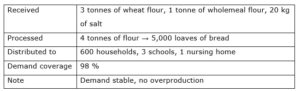
Financial accounting is replaced by a material and impact balance sheet. It documents the quantities used and the demands met. Based on this data, work and delivery processes can continue to be planned and improved.
Employees are motivated by the obvious social benefits of their work, not by individual remuneration.
Example 2: Battery production
In a large industrial plant manufacturing battery modules for electric vehicles, the transition is proceeding in the same way. The existing production lines, storage structures and supply chains remain completely intact. Suppliers from the raw materials processing and electronics manufacturing sectors continue to deliver as usual.
Financial coordination is replaced by a demand-oriented reporting system that records material flows, energy consumption and distribution results.
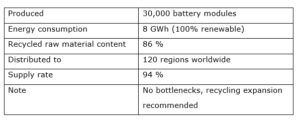
The previous financial accounting system is no longer used. Control is based on demand data: Which regions need how many batteries in what time frame?
The existing ERP systems remain usable, as they manage quantity, time and location data anyway. Only the money-related columns (costs, prices, revenues) are deactivated. This means that operations can continue without any structural adjustments.
Technical implementation
The technical basis for the transition is already in place. Modern enterprise software (ERP, logistics and production systems) works with real quantity and time data, which was previously used to calculate monetary values. In the new structure, these monetary values are simply no longer needed.
This means that the data architecture remains identical. Only the evaluation logic is adjusted (e.g. from ‘cost optimisation’ to ‘supply level’). Supply and production networks remain active and unchanged.
This means that global supply can be maintained without having to rebuild production chains.
New types of balance sheets
The traditional financial balance sheet is replaced by impact and supply balance sheets. These are not used for evaluation, but for overview and optimisation.
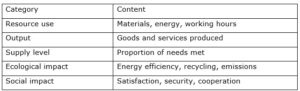
This type of balance sheet allows for precise analysis without resorting to monetary values. It measures the real benefits of work and the effectiveness of supply. This means that planning remains possible, but without economic pressure or profit targets.
Result
The switch to voluntary work does not jeopardise supply. As the material, logistical and informal structures remain intact, the economy continues to function – with the same technical foundation, but without money-based mediation.
Production remains stable, distribution becomes more transparent, and control is based on demand data rather than purchasing power. Overall, the administrative burden is significantly reduced, while real coordination becomes simpler and more transparent.
The result is not a new mode of production in the technical sense, but a reorientation of the purpose: from profit-seeking to demand-oriented supply.
Infrastructure projects
Special projects are mainly regional in nature. They are decided upon by local authorities on a grassroots democratic basis.
As overall production declines because there is no longer any pressure to grow, it will not be a problem to find producers for individual projects.
For example, it will no longer be necessary to favour large-scale projects such as motorway construction because transport will decline rapidly. It will no longer be necessary to transport milk from the north to the south because it may generate 2 pence more revenue there. This will probably affect most of the products that will later be produced mainly regionally. A reduced infrastructure will suffice for high-quality and durable products.
But if a community decides to build a regional health centre, a corresponding request will be published on the internet and the AI will ensure that all potential companies are informed. There may be cooperative associations, perhaps the construction workers will come with their families and use this for cultural and social exchange. Housing is available free of charge and, due to its gift nature, everyone is eager to maintain it.
Supplies for this construction project are provided as needed and as requested. Today’s industry is flexible enough to respond to this without having to draw up a five-year plan.
6. Social changes
6.1. Power of society
The driving force in society is no longer to work in order to earn a wage, because otherwise you will starve.
The driving force in society is to help ensure that everyone has enough to eat.
6.2. Taxes and social systems become superfluous
In a society where everyone has unrestricted access to everything necessary for life, there is no longer any need for traditional capitalist social systems based on the organisation and administration of poverty and inequality.
These systems originally emerged under capitalism to alleviate the existential insecurity of the working class, while at the same time preserving the capitalist system of production and labour as a commodity. The state – or rather the existing system – acts as an intermediary, ensuring that workers can continue to work for capital.
In a society without profit and wage labour, where production is voluntary and everyone has access to the necessary resources regardless of the labour market, the entire bureaucratic apparatus that was necessary to maintain these social systems becomes superfluous. This is because everyone has unconditional access to everything they need for a happy and contented life.
In such a society, unemployment insurance, which originally served to cushion the precarious existence of workers in times of unemployment, becomes superfluous. For in a society in which every person is provided for through voluntary work and the principle of giving, this mechanism of social security, which is based on the ongoing necessity of wage labour, becomes obsolete.
The same applies to the pension insurance system. In a society where all people are automatically provided for, there is no need to save money for old age. There are no social classes divided into different social situations by the compulsion to wage labour and the associated existential pressure. Everyone is equally provided for, regardless of their position in the labour market.
Administration, education and culture, which in capitalist societies are often regarded as sectors secured by taxes and state funding, can now be organised in a completely new way in a voluntary society. In a world without financial constraints and the need to cover social needs through taxes, education and culture can be made freely and equally accessible to all.
Education, which in capitalist systems is often treated as a commodity that not everyone can afford, now becomes accessible to all. In a society where the well-being of all people is the top priority, education is not a question of income, but a communal process organised through collective responsibility and solidarity.
Cultural and social work as a collective responsibility
Culture, which is often commodified in capitalist societies, also undergoes a fundamental change. It is no longer seen as a product of the ‘entertainment industry’ or as a status symbol, but as a common good that serves society and is created by it.
In a society without financial incentives, people are no longer forced to earn a living doing jobs that do not suit them or that only serve the profits of others. Instead, they can develop their talents in cultural and creative fields without being affected by financial worries or the pressure to commercialise.
6.3. The financial system is disolving
On the day we give up wages, the financial system will dissolve. It will no longer have any access to the economy because there will be no more exchange value.
Tax offices will also no longer be needed, as there will be no more taxes. Even if taxes still existed, we would not know what to do with them, because nothing can or needs to be bought with them anymore.
Insurance companies will also become superfluous, because damage can simply be repaired without incurring any costs.
Basically, this is not a problem because no material values are created within the financial and insurance system, so no one will be missing anything if the financial system no longer exists. On the contrary, much less electricity will be consumed, which will have a direct impact on greenhouse gas emissions.
In addition, many high-quality buildings will become vacant and can be used for other purposes. Furthermore, there will be a large workforce available, initially working a few hours a week where needed. Over time, these people will contribute to society with their natural talents.
The dissolution of the financial system will therefore only bring advantages.
6.4. Property
The role of property
For almost the entire history of humankind, property as we know it today was virtually unknown. Tools and weapons belonged to the person who used them, but land, water, forests and animals were considered common goods that belonged to no one.
But with a growing population, technological advances and power differences, individuals or groups began to appropriate these resources. The decisive moment was the social acceptance of this appropriation: whoever fenced off or controlled land was soon considered its rightful owner, provided they had the power to enforce this. Violence, religion and later the legal system secured this state of affairs.
Thus, the natural basis of life – the earth itself – was transformed into a commodity. What had previously been shared as a matter of course could now be sold, inherited or hoarded.
In capitalism, property is much more than a means of individual security – it is the central instrument for maximising profit. Whether factories, rental apartments or fallow land: property exists to accumulate capital. Even owner-occupied flats generate profit because no rent has to be paid and the money saved can be used elsewhere.
Even uncultivated land increases property prices by reducing the amount of land available – also in the service of exploitation.
Why do we simply accept this today?
Because the property system has become the cultural and legal norm. Over thousands of years, it has been religiously justified (‘God gave the earth to man’ – but not equally to all), philosophically defended (Locke: labour establishes property) (Locke, 2008) and economically declared the foundation of every order. This theory of property, which is based on the state of nature, serves as Locke’s basis for justifying the state and the necessity of a social contract. This state is supposed to protect property rights.
Furthermore, survival in capitalism depends directly on access to property or work – therefore, property appears to be ‘natural,’ even though historically it was a product of violence and exclusion.
Profit and its dissolution
The crucial question is: How can this logic be overcome?
The answer lies not in the expropriation of the means of production, but in the abolition of profit itself. Without profit, property loses its function as an instrument of domination – it becomes functionless. Owners then no longer have any incentive to hold on to their property, as it no longer yields any returns but still requires maintenance, administration and risk. Since there is no longer a market, they cannot sell it either.
What remains is the simple insight that property has become superfluous. It dissolves – not through coercion, but through the loss of its purpose.
No appropriation
Even well-intentioned models of collective ownership – cooperatives, councils, municipal enterprises – do not transcend the logic of property. They merely manage property more equitably, but they do not dissolve it. Even socialisation remains a form of appropriation, often accompanied by coercion or conflict.
The idea that property dissolves by itself through loss of function is therefore not only more practicable, but also more morally convincing.
This requires a qualitative leap: the complete decoupling of the economy from the financial system. Only when profit disappears as the driving force behind exploitation will the economic basis of property collapse. What remains is the free, shared use of resources – a world without property, without profit, without classes.
This dissolution takes place without violence. Expropriation becomes superfluous because property itself loses its meaning.
The transition
During the transition period, there will still be a formal legal obligation to protect property. Article 14 of the Basic Law (Grundgesetz, 2025) stipulates that property is both protected and committed to the common good. But as soon as property no longer has any economic value, it becomes a burden.
This is precisely where the new opportunity lies: what used to be property can be given to the community. This is not expropriation, but a conscious surrender – a return to the commons, as was commonplace throughout much of human history.
This step has a liberating effect. The owner becomes a guardian: they protect and share instead of excluding and managing. Possession is transformed from a means of power into a responsibility towards the whole.
Protecting your privacy
Even in a society without property, the protection of privacy remains a central concern.
No one will be forced to share spaces they do not want to share simply because property ownership or rental prices dictate it. People will choose their places of residence, flatmates and lifestyles voluntarily – and for social rather than financial reasons. Personal space will not be socialised, but respected, because there will no longer be any need to control or exploit it economically.
Technological aids, for example in the field of communication or automated supply, are designed in such a way that they respect individual spheres and do not monitor them. A world without property can thus also be a world with greater respect for privacy – because it is no longer violated by property interests.
Conclusion
The only solution lies in the complete overcoming of the financial system and profit. Only when profit disappears as the driving force behind exploitation will property relations dissolve – not through laws, expropriation or redistribution, but through the devaluation of their basis. Property loses its function and collapses. What remains is the free, shared use of resources – a world without property, without profit, without classes.
Avoiding forced expropriation will also ensure that the transition to a classless society can take place without violence.
6.5. Liberation of labour
When work is no longer subject to financial constraints but is performed voluntarily, its entire character changes. It becomes an expression of creativity, self-realisation and social contribution. Motivation no longer stems from the pressure to survive, but from the joy of the activity itself.
This marks a historic break with capitalist wage labour.
There are convincing arguments and empirical evidence that the drive to perform voluntary, community-oriented work is deeply rooted in human nature – regardless of financial incentives. This is not only based on anthropological observations, but also on findings from psychology, sociology, behavioural economics and neuroscience.
In primitive societies, work was motivated not by money, but by the direct satisfaction of needs and social cohesion. Cooperation was essential for survival: those who did not contribute were excluded or considered unreliable. Hunting, gathering, childcare, protecting the group – all of this was done voluntarily, without exchange or wages. The drive to work together served to preserve the species. Sources such as ‘The Original Affluent Society’ (Sahlins, 1966) and ‘Hierarchy in the Forest’ (Boehm, 2001) provide impressive evidence of this.
These conditions applied to more than 95 per cent of human evolutionary history.
Modern psychological and neuroscientific studies also confirm that altruism and cooperation trigger happiness hormones such as oxytocin and dopamine. Voluntary helping activates reward centres in the brain – comparable to eating or sex.
The so-called ‘helper’s high’ has been scientifically proven, among other things in Sonja Lyubomirsky’s book ‘The How of Happiness’ (Lyubomirsky, 2008) and in Deci & Ryan’s self-determination theory on intrinsic motivation (Ryan & Deci, 2000).
The drive to volunteer in the service of the community is therefore deeply rooted in evolution and has remained culturally alive. It manifests itself in forms that are not tied to money: care, creativity, development work, mutual assistance. This drive is not a utopia, but everyday reality – it is just often overshadowed or distorted by the logic of money. When external constraints such as money are removed, this inner drive can become effective again.
Overcoming alienation
Karl Marx criticised capitalist labour as alienating because it separates people from their product, their activity, their fellow human beings and themselves. Only by abolishing the logic of wage labour can work belong to people again.
Each person can then freely and independently choose an activity that suits their inclinations, abilities and talents, without being forced to earn a living.
In a society where the logic of wage labour has been overcome, most people will, over time, be able to do exactly what they really enjoy doing – whether it be baking, programming, caring, designing or even cleaning. Those who enjoy baking will also get up at four in the morning from time to time to bake bread rolls and croissants for other people, not out of compulsion, but out of a love for what they do.
In this way, many jobs will be filled from within – through personal enthusiasm rather than economic pressure. It is important to prevent monotony through solidarity-based change.
Solidarity-based organisation of unpleasant work
For necessary but unpopular tasks that cannot be performed by volunteers or machines, solidarity-based rotation systems will be developed that are controlled by grassroots democracy and filled on the basis of solidarity.
The decision to participate remains voluntary, but is supported by an awareness of social responsibility, of doing something for others in return for the daily gifts received. Distribution is not based on wage incentives, but on principles of solidarity and a sense of community.
In an economy freed from the financial system, technological progress can finally be used in a people-centred way. Robots no longer replace humans for profit, but specifically take on the most physically demanding and monotonous tasks.
An end to global exploitation
Today’s global economy is based on the exploitation of cheap labour, especially in the Global South – for example, in raw material extraction or textile production. In the society of the future, this relationship will become obsolete. It will no longer matter whether a pair of trousers is sewn by a person in Asia or a person in Europe.
No one will have to work under duress anymore. If people refuse to perform certain tasks, this will not be seen as a problem, but as a necessary correction of a historically grown injustice, and solutions will be sought through grassroots democracy.
6.6. The role of entrepreneurs in the transition
Many people wonder whether entrepreneurs would voluntarily give away their products if no one demanded wages or profits anymore. The answer depends on whether we really make the transition simultaneously worldwide – and that is precisely the crucial point.
If everyone worldwide worked voluntarily and all basic needs were met, then no one would need money to survive. Entrepreneurs and their families would also be fully provided for; they would no longer need to make profits, nor would they be able to buy anything with those profits. The financial pressure would disappear, as would the constant fear of bankruptcy, competition and market loss.
This fundamentally changes the meaning of their work. Instead of constantly developing new sales strategies or cutting costs, they can finally concentrate on what originally motivated them: manufacturing good, durable, useful and recyclable products. Their knowledge of production, organisation and technology remains valuable – but now serves everyone, not just private enrichment.
New forms of enterprise – without profit, without exploitation
In this mode of production, no one profits from companies anymore. This eliminates the economic incentive for exploitation. Entrepreneurs no longer act as capital owners, but as coordinators of meaningful processes.
They design sustainable forms of production together with other employees, who remain with the company or move on of their own free will – depending on where they can best develop their skills.
Managers are no longer measured by how much profit they generate or how much they reduce costs, but by how much they convey trust, cooperation and meaning.
Control is replaced by role models. A good leader inspires through attitude, not power. They organise not to achieve goals, but to empower people to contribute their best. Motivation no longer comes from rewards or fear, but from shared responsibility for the success of the whole.
Leadership thus becomes a form of service – a hub of coordination, empathy and orientation. The formerly hierarchical role is transforming into a cultural and social task: keeping the spirit of giving alive and enabling everyone to enjoy the joy of working together.
In the vast majority of companies, entrepreneurs will quickly adapt to the new circumstances and perceive liberation from the pressure to make a profit as liberation from a burden.
In an emergency, voluntary global renunciation also has the potential to become a global general strike.
6.7. What will become of the state?
Why do we need the state and power today? We need the state to protect property and power to enforce interests. Mostly these are financial interests, to strengthen areas of the economy. In ‘Benharmonia’ there are no more disputes over money because money has become superfluous.
Likewise, it is superfluous to protect property because there is no longer any use for it. Initially, there is still a duty to care for and maintain it, but gradually property will become common land.
Decisions are made collectively. Local councils, connected by open communication networks, form the backbone of the grassroots democratic organisation. Everyone can play an active role. Power has been replaced by responsibility. Within the relevant communities, decisions on whether to build a new road or school are made on a grassroots democratic basis.
The police and judiciary will probably no longer be needed in their current form. Most crimes, such as robbery, drug and human trafficking, fraud or tax evasion, have something to do with money, and money no longer exists. There will certainly still be isolated cases of violence due to jealousy or similar reasons, but these problems can be solved by civil society, perhaps with a kind of lay court.
Even the few remaining cases that are currently punished with imprisonment can certainly be dealt with in other ways. With therapy or role models, for example. I must point out again and again that people change. The most accurate description for this is living in brotherhood. Excluding someone will then no longer be part of our self-image.
With the disappearance of money and the need for central administration, the state loses its previous functions. The organisation of society is increasingly decentralised, based on voluntary associations and local cooperation. In this process, ethnically or culturally grown structures take on new significance – not as exclusive boundaries, but as places of lived identity and mutual trust.
The ‘peoples’ in the original sense – communities with a common language, history and way of life – will once again take responsibility for their living spaces.
There will no longer be any power relations between them, but rather networks of mutual support. This will create a new relationship between the local and the global: cultural diversity will be preserved, while the material basis of existence will be shared globally.
In past centuries, colonisation drew arbitrary borders and caused much suffering as a result. When states disappear, these borders naturally disappear as well. Perhaps ethnically related peoples will emerge again.
People will visit each other, even stay longer and enrich each other culturally.
There will no longer be refugee flows as we know them today. Today, people flee poverty and war. With money, poverty automatically disappears. Once there is no longer a market, goods can be distributed fairly.
What will happen to the military, weapons and war?
When the economy is converted to sustainable production methods, a consistent circular economy will emerge. In conjunction with much lower consumption, natural resources will hardly be exploited at all. We can therefore rule out war over resources.
Since there will be no more profit, no one will be interested in manufacturing weapons anymore.
6.8. Luxury goods and ‘dirty work’
(See 4.5. The limits of our imagination ) It is often observed that predictions about a post-capitalist society are based on false assumptions. The reason for this is that we find it extremely difficult to truly imagine ourselves in such a society. We usually try to understand it using concepts and thought patterns from the world we know – a world in which work, property and money play a central role. But these categories lose all meaning in a voluntary, money-free and solidarity-based society. Our imagination is bound to the conditions of the present. We tend to pick out individual facts or habits and transfer them to the future, even though they no longer apply there. But a new post-capitalist society does not arise through the transformation of the old, but through the abolition of its foundations. When we try to imagine mobility in such a society, for example, we automatically think of cars, roads, traffic jams and commuting. Perhaps we would think that one car per family would be sufficient. But in a society where work is unpaid, there is no longer any need to commute between home and work every day. No one would have to travel long distances anymore because they earn more money there. Mobility would not disappear, but its purpose would change: it would no longer serve the compulsion to work for a living, but rather to meet people, cooperate and enjoy exchanges. There would no longer be any ‘commuting’ because it would not make sense. How many people would then still bother to own a car? The same applies to almost all areas of life. Living, working, learning, researching, travelling – all of these will lose their current, economically determined form. We will no longer ask ‘how much does it cost’ or ‘is it worth it’, but only whether it is meaningful and useful for our shared life. A major barrier to our understanding lies in the question of what and how much we actually need. We are so used to the idea that wages must be equal – that women should earn as much as men and that collective agreements stipulate that thousands of people receive the same wage. This habit makes it difficult for us to consider that every person has individual needs and circumstances. Some need more, others less. Even family size should actually influence the level of wages. Marx pointed out this contradiction in his critique of the Gotha Programme (Marx, 1875). Concepts such as working time accounting cannot really solve this problem either. Nevertheless, it is difficult for us to imagine a society in which wages are calculated according to family size or lifestyle. And yet this is precisely what would be necessary if we want to imagine a society in which true justice is determined not by equal wages but by the fulfilment of human needs. The most difficult thing is probably to imagine situations that are characterised by extreme scarcity today. These are luxury items such as expensive jewellery, expensive cars, expensive holidays or expensive flats – they are unattainable for most people and therefore most desirable. Try to imagine this future situation when money has disappeared because everything – yes, everything – is free. Suddenly, we could simply take anything we wanted, theoretically even expensive jewellery, expensive cars, expensive holidays or expensive flats. We could theoretically even bathe in champagne every day. These goods would then no longer be ‘scarce’. How desirable would they still be? But more importantly, these things would no longer have a price. We would no longer be able to tell whether they were once luxury items. I would be reluctant to squeeze into a Maserati sports car or be responsible for cleaning a huge flat with lots of shiny surfaces. In this society, we will prefer things that are practical. Moreover, in a supportive and fraternal environment, no one needs to stand out. Jesus Christ is said to have always said during his lifetime: ‘The last shall be first, and the first shall be last.’ (Matthew 19:30) (Testament, 1999) Is that perhaps what is meant? It will be similar with ‘dirty work’. Today, it is done by people who depend on the money they earn for it. Anyone who has the chance to earn more money will not exactly seek out this kind of work. In the new society, we will deal with this in a spirit of solidarity and take turns, so that many people share the little dirty work that remains. Much of this work can then be automated when the decision-making criterion of money no longer means that cheap labour costs much less than the use of robots. Once car factories have been converted for the production of robots, and once there is hardly any waste left due to almost complete recycling, the problem of ‘dirty work’ will become relative. So if you want to get an idea of how we will live in a post-capitalist society, you must be prepared to question all the basic assumptions on which our current way of thinking is based. We must let go and simply trust in this security, which will then be characterised by solidarity and brotherhood. Only when we take this step will our imagination be free enough to conceive of the new. We must pass through the famous ‘eye of the needle’.
7. Global impacts
The global introduction of voluntary, unpaid work within the framework of Benharmonia marks the end of the historical era of global dependencies. The previous division between ‘rich’ and ‘poor’ regions of the world loses its meaning.
From inequality to mutuality
In the capitalist world order, the unequal distribution of capital, technology and power formed the basis of an asymmetrical division of labour: the North concentrated wealth, industrial capacity and political control, while the South served as a source of raw materials and a sales market. Under the conditions of Benharmonia, these structures lose their function.
With the abolition of property, money and competition, the principle of dependency also disappears. Instead of exchange relationships, material and social reciprocity emerges. Each region contributes what it has – soil fertility, knowledge, craftsmanship, organisational traditions – and receives what it needs.
This makes true equality possible for the first time: not as formal equality, but as lived cooperation.
The rediscovery of cooperative cultures
While capitalist modernity in the North has largely produced individualised ways of life, in many places in the South there are still remnants of communal and solidarity-based structures – village communities, local councils, clan and family associations, forms of mutual aid and collective responsibility.
Concepts such as the South African Ubuntu (‘I am because we are’) or the indigenous Sumak Kawsay or Buen Vivir from the Andean regions embody an ethic of togetherness in which the well-being of the individual is inextricably linked to the well-being of the community and nature.
Such ideas, which have never completely disappeared in the Global South, form the cultural sounding board for new global forms of communal responsibility in Benharmonia.
These historically grown social patterns take on unexpected significance in the new context: they serve as living examples of social organisation beyond the state and the market.
Countries in the Global South today mostly live more simply than those in the Global North. We can see this clearly from the fact that these countries‘ Country Overshoot Day (Footprint, 2025) falls in the last months of the year. Durinig the transition they will probably still need help from the surplus of the North. But soon they will be an example to the North of sustainable living.
Instead of the North ‘modernising’ the South, the opposite is now happening. People from the countries of the North, alienated from community life, are travelling to the South to work there – not as ‘helpers’ but as learners. They participate in the restoration of destroyed ecological and social structures, help build large dams against sea level rise or green deserts, and participate in ways of life based on mutual responsibility and direct cooperation.
In this way, the South becomes a source of cultural and social renewal for all of humanity.
Return flow of social experience to the North
The experiences from the South are beginning to profoundly change societies in the North. In former industrial regions, where work and social structures had largely disintegrated, new forms of coexistence are emerging, modelled on Southern communities: neighbourhoods, regional associations, cooperative workshops and open learning centres.
The North is learning to understand social relationships as a productive force once again. Technological knowledge continues to flow into joint development, but it is subordinated to the needs of the communities.
The historical one-sidedness of ‘civilisation’ is being reversed: progress no longer means technical mastery, but social connectedness.
A new cultural symmetry
Under the conditions of Benharmonia, a new cultural symmetry emerges. The North contributes experience in science, technology and organisation, while the South contributes social and ecological wisdom, cultural continuity and practical forms of community spirit.
The interaction of these two currents gives rise to a planetary culture in which the knowledge of one part of humanity no longer dominates the other, but connects with it.
Terms such as Ubuntu, Buen Vivir and Sumak Kawsay become universal symbols of a shared ethic that is no longer limited to a particular region. They describe an attitude that becomes concrete in everyday life in Benharmonia – in solidarity, shared responsibility and mutual care.
The terms ‘North’ and ‘South’ are gradually losing their political and economic significance. They then refer only to geographical areas of a shared, multi-voiced global society.
Outlook
The end of global inequality is evident not only in the distribution of goods, but above all in the restoration of human relationships. The dissolution of the rule of money enables a return to social forms based on trust, closeness and shared responsibility.
After centuries of exploitation, the Global South thus becomes the starting point for a new social culture that renews humanity itself.
In this sense, Benharmonia means not merely an economic upheaval, but the rediscovery of humanity as a whole on Earth.
The author
Eberhard Licht was born in 1955 in the small theatre town of Meiningen in southern Thuringia. After studying process engineering at university, he worked at a research institute in the construction industry.
The second third of his life began after the fall of the Berlin Wall. This part was dominated by the task of conquering market shares. First, he established a branch of a south-western German chemical institute in Weimar, and later he founded his own accredited testing institute for industrial emissions measurements in Berlin.
The third phase began in 2010, when Eberhard realised that the two younger of his four children needed more time and attention. He sold his company and stopped working for money. He quickly discovered how fulfilling housework can be when it is not subject to patriarchal rule. For several years, he also volunteered at a homeless shelter in Utrecht, the Netherlands – until the coronavirus pandemic put an end to this work.
Since then, he has devoted all his energy to developing the present plan for the liberation of work, people and the Earth.
Bibliography
Ariely, D. (2009). Predictably Irrational, Revised and Expanded Edition: The Hidden Forces That Shape Our Decisions. New York: HarperCollins.
Bibel, D. (2017). Einheitsübersetzung. Altes und Neues Testament. Freiburg: Verlag Herder.
Bockelmann, E. (2020). Das Geld: Was es ist, das uns beherrscht. Berlin: Matthes & Seitz.
Boehm, C. (2001). Hierarchy in the Forest The Evolution of Egalitarian Behavior. Cambridge: Harvard University Press.
Boff, L. (2018). Traum von einer neuen Erde. Wien: LIT VERLAG.
Bollier, D. (2025). Think Like a Commoner, Second Edition: A Short Introduction to the Life of the Commons. Gabriola BC: New Society Publishers.
Bos, R. t. (2017). Dwalen in het Antropoceen. Amsterdam: Boom.
Breitfeld, A. (2024). https://www.rbb24.de/panorama/beitrag/2024/12/berlin-neukoelln-frank-zander-weihnachten-obdachlose.html. rbb 24.
Büllesbach, D. (2019). European Dream. In S. K. Michael Timmermann (Herausgeber), Wann wenn nicht wir* Ein Extinction Rebellion Handbuch E-Book (S. 255). Frankfurt am Main: S. Fischer.
Calvez, B. (2021). Saruj: Stell‘ dir vor, es gibt kein Geld mehr. Bad Belzig: Meiga Verlag.
Cheal, D. (2015). The Gift Economy (Routledge Library Editions: Social and Cultural Anthropology) . London: Routledge.
Chomsky, N. (2001). War Against People. Hamburg: Europa Verlag.
CPIM. (kein Datum). Parteiprogramm der kommunistischen Partei Indiens. https://cpim.org/.
Daniel Yudkin, A. P. (5 2022). Prosocial correlates of transformative experiences at secular multi-day mass gatherings. Nature Communications, S. 2600.
Destatis. (2016). Pressemitteilung „In Deutschland wird 35 % mehr Zeit für unbezahlte Arbeit (Haushalt, Pflege, Ehrenamt) aufgewendet als für bezahlte Erwerbsarbeit. Von https://www.destatis.de/DE/Presse/Pressemitteilungen/2016/04/PD16_137_812.html abgerufen
Émile Durkheim, K. E. (1995 / 1912). The Elementary Forms of Religious Life. New York: Simon & Schuster Ltd.
Engels, F. (1894). Herrn Eugen Dühring’s Umwälzung der Wissenschaft (Anti-Dühring). Stuttgart: Dietz (in MEW 20).
Erich Meadows, D. u. (1972). Die Grenzen des Wachstums. Bericht des Clubs of Rome zur Lage der Menschheit. Stuttgart: Deutsche Verlagsanstalt.
Ernst Fehr, S. G. (10. January 2002). Altruistic punishment in humans. nature, S. 137-140.
Felber, C. (2018). Gemeinwohl-Ökonomie: Das alternative Wirtschaftsmodell für Nachhaltigkeit. München: Piper Verlag GmbH.
Footprint. (2025). Earth overshoot day. Von https://overshoot.footprintnetwork.org/newsroom/country-overshoot-days/ abgerufen
Federici, S. (2020). Aufstand aus der Küche. Münster: edition assemblage.
Franziskus, P. (2015). Laudato si. Freiburg: Herder.
GG, A. 1. (2025). Grundgesetz für die Bundesrepublik Deutschland . BGBl. I.
Grundgesetz. (2025). Gesetze im Internet. Von Grundgesetz für die Bundesrepublik Deutschland: https://www.gesetze-im-internet.de/gg/ abgerufen
Habermann, F. (2018). Ausgetauscht Warum gutes Leben für alle tauschlogikfrei sein muss. Köln: ULRIKE HELMER VERLAG .
Harvey, D. (2007). A Brief History of Neoliberalism. Oxford: Oxford University Press, USA.
Hickel, J. (2023). Weniger ist mehr: Warum der Kapitalismus den Planeten zerstört und wir ohne Wachstum glücklicher sind. München: oekom verlag GmbH.
ILO. (2018). CARE WORK AND CARE JOBS FOR THE FUTURE OF DECENT WORK. Von https://www.ilo.org/sites/default/files/wcmsp5/groups/public/@dgreports/@dcomm/@publ/documents/publication/wcms_633166.pdf abgerufen
Indigo Drau, J. K. (2024). Alles für alle. Stuttgart: Schmetterling Verlag.
Jackson, T. (2017). Wohlstand ohne Wachstum. München: oekom verlag GmbH.
Kallis, G. (2018). Degrowth (Economy: Key Ideas). Newcastle upon Tyne: Agenda Publishing.
Karl Marx, F. E. (1987). MEW / Marx-Engels-Werke Band 19. Berlin: Karl Dietz.
Karl Marx, F. E. (2000). MEW / Marx-Engels-Werke Band 34. Berlin: Karl Dietz.
Kearney, K. H. (2025). Statistical Review of World Energy 2025. London: Energy Institute.
Keynes, J. M. (2024). Wirtschaftliche Möglichkeiten für unsere Enkel. Ditzingen: Reclams Universal-Bibliothek.
Kohn, A. (1999). Punished by Rewards: The Trouble with Gold Stars, Incentive Plans, A’s, Praise and Other Bribes. Boston: Mariner Books.
KPRF. (kein Datum). Programm der kommunistischen Partei der russischen Förderation . https://kprf.ru.
Latouche, S. (2015). Es reicht!: Abrechnung mit dem Wachstumswahn. München: oekom verlag GmbH.
Leo, P. (2025). „Dilexi te“. Rom: Vatican News.
Locke, J. (2008). Zwei Abhandlungen über die Regierung. Berlin: Suhrkamp.
Lucas, P. (2016). Utopia ist machbar 20 Jahresplan für eine globalisierte Welt von Wohlstand, Frieden, sozialer Gerechtigkeit und individuellem Glück für alle. Berlin: Pro Business.
Lyubomirsky, S. (2008). The How of Happiness: A New Approach to Getting the Life You Want. New York: Penguin Publishing Group.
Marx, K. (1875). Kritik des Gothaer Programms Marx-Engels-Werke Band 19. Berlin: Dietz-Verlag.
Mauss, M. (1990). Die Gabe: Form und Funktion des Austauschs in archaischen Gesellschaften . Frankfurt a. M.: Suhrkamp.
Meretz, S. S. (2018). Kapitalismus aufheben. Hamburg: VSA: Verlag.
Nelson, A. (2022). BEYOND MONEY: A Postcapitalist Strategy. London: Pluto Press.
NOAA Network, G. G. (2025). Barrow, Alaska, Mauna Loa, Hawaii, American Samoa, and South Pole, Antarctica: The Global Monitoring Laboratory (GML) of the National Oceanic and Atmospheric Administration (NOAA).
OECD. (2019). Schätzungen, dass der Anteil der unbezahlten Sorgearbeit in manchen OECD-Ländern vergleichbar zu großen Wirtschaftssektoren ist. Von https://www.oecd.org/content/dam/oecd/en/publications/reports/2019/06/enabling-women-s-economic-empowerment_7e05c98b/ec90d1b1-en.pdf abgerufen
Opielka, M. (1997). Gemeinschaft und Vertrauen in der Familie: Soziologische und pädagogische Aspekte. In Schweer.
Ostrom, E. (2015). Governing the Commons: The Evolution of Institutions for Collective Action. Cambridge: Cambridge University Press.
Paech, N. (2025). Befreiung vom Überfluss – das Update: Eine Postwachstumsökonomie für das 21. Jahrhundert. München: oekom Verlag.
Paetorius, I. (2023). Um-Care Wie Sorgearbeit die Wirtschaft revolutioniert. Ostfildern: Patmos Verlag.
Preissing, S. (2021). In Zukunft ohne Geld. Berlin: Mandelbaum.
Raworth, K. (2018). Die Donut-Ökonomie: Endlich ein Wirtschaftsmodell, das den Planeten nicht zerstört. Berlin: Carl Hanser Verlag GmbH & Co. KG.
Robinson, K. S. (2020). The Ministry for the Future. London: Orbit.
Rudolf, U. R. (2023). #CloseEconDataGap: den politischen und ökonomischen Blindflug durch die Erfassung der unbezahlten Arbeit überwinden. In I. P. Uta Meier-Gräwe, Wirtschaft neu ausrichten (S. 207-214). Opladen Berlin Toronto: Barbara Budrich.
Ryan, R. M., & Deci, E. L. (2000). Self-determination theory and the facilitation of intrinsic motivation, social development, and well-being. American Psychologist. 55 (1): 68–78., S. 68-78.
Sahlins, M. (1966). The Original Affluent Society. Parma: Università degli studi di Parma.
Schäfers, B. (2016). Einführung in die Soziologie. Wiesbaden: Springer VS.
Scherf, E. (2016). Anders denken: Eine Welt ohne Geld: Von allem weniger und von Liebe mehr . Hamburg: BoD – Books on Demand.
Schmelzer, M. (2022). The Future Is Degrowth A Guide to a World beyond Capitalism. London New York: Verso.
Siddharth Prakash, G. D. (2016). Einfluss der Nutzungsdauer von Produkten auf ihre Umweltwirkung: Schaffung einer Informationsgrundlage und Entwicklung von Strategien gegen „Obsoleszenz“. Dessau: Umweltbundesamt.
Silke Helfrich, D. B. (2019). Frei, fair und lebendig – Die Macht der Commons. Bielefeld: transcript Verlag.
Smith, A. (2023). An Inquiry into the Nature and Causes of the Wealth of Nations). Weinheim: Wiley.
Stern, A. P. (2019). Redesigning Civilisation. Probstzella: Continentia Verlag.
Testament, D. n. (1999). Die Heilige Schrift 2. Teil. Wuppertal: R. Brockhaus.
Tim Cornell, K. L. (2012). ‚Bread and Circuses‘: Euergetism and Municipal Patronage in Roman. London: Routledge.
UN-Bericht. (2016). Unbezahlte Sorge- & Hausarbeit wird auf 10-39 % des BIP geschätzt in verschiedenen Ländern. Von https://documents.un.org/doc/undoc/gen/n17/000/25/pdf/n1700025.pdf abgerufen
Young-joo Ahn, E. M. (2023). Relationships between Community Festival Participation, Social Capital, and Subjective Well-Being in a Cross-Cultural Context. Healthcare, S. 2361.
Yuan Yuan, T. X. (24. 6 2019). Gift Contagion in Online Groups: Evidence From Virtual Red Packets. Management Sciences https://arxiv.org/pdf/1906.09698.
(2022). Zeitverwendungserhebung (ZVE). Wiesbaden: Statistisches Bundesamt.
Ziegler, J. (2015). Ändere die Welt!: Warum wir die kannibalische Weltordnung stürzen müssen. München: C. Bertelsmann.